
17. Artificial Intelligence vs Analogue Inspiration
Updated: Dec 4, 2025
SvBeyond.com, what is our relationship with tech and in particular AI?
Bearing in mind that I solo-sailed the Atlantic, fundamentally guided by an app on my phone for navigation, so I am not a Luddite. I have all sorts of tech systems on the boat: multiple GPS sources, AIS, VHF, solar, EPIRB, right down to paper charts and a sextant. Redundancy all over the place.
When I first started this website some two years ago, I created a placeholder first. A brochure in the sky, as I called it. Four or five general blog posts about what this site was all about, as far as I could see then.
It helped me create a focus for myself as I started to record my journey.
By necessity, it felt that I could only be general and not specific. A sailing generality vs a meaningful specific to paraphrase Zig Ziglar.
For one, I hadn't worked out what the website was about, who it was for, and what my purpose for creating and populating it was. But I knew it was something I wanted to create. Just not why.
At the time, AI was blowing up. Or I should say, was starting to blow up. Chatgpt was out and Leonardo.ai for instance.

And a few others - in fact more than a few. A little bit like a gold rush. A little bit like the dotcom bubble.
It was fascinating. In a sentence or two, I could prompt engineer an article of, say, 1,000 words. If I didn't like what it put out, I could get it to do it again. I could double the length. Change the tone. Emphasise this, de-emphasise that. It literally felt like you were playing with a genie granting you wishes.
I could write prompts and generate artwork in the style of Van Gogh. Generate. Re-generate. Iterate. Re-iterate. For a person who is a reasonable photographer this was amazing. I was an artist now!
Then there was Udio.com. I could now create music. Oddly enough the 'unleashing of creativity' is creating websites that kind of look the same.

But I started to play with it. Mixed results. Most of it a bit rubbish. My 19 year old son called it AI-slop. He was right. But still very cool.
And we have all seen it. The internet now has crossed a Rubicon - more content on the internet is generated by AI than by humans (https://graphite.io/five-percent/more-articles-are-now-created-by-ai-than-humans). And of course, AI crawls the internet for its training and then outputs it. Imagine that doom loop. AI slop generating more AI slop in an infinitely degenerative slope.
Creatives are justifiably miffed. They create stuff that has taken years of personal and professional development to get good at and, because it's on the internet, it's available free of charge.

Analysts are saying that any creative job can already be done better by AI than a human. One interview was telling. A podcaster interviewed an AI expert, loads of credentials, decades of relevant experience, and was told he was already redundant and archaic. An AI could analyse every single podcast he had done, analyse his style, the sort of questions he asked, the exchanges he tended to have. It could generate his set, obviously, but could also generate a video image, complete with perfect vocals, in real time. And of course all of that is kind of terrifying. What takes it to another level, is that the AI can also analyse the impact his podcast has - it can measure and analyse engagement, eyeballs, subscriptions, superchats, whatever, and tailor its outputs to maximise any or all of these metrics.
An AI can do that today in 2025.

It can do Joe Rogan better than Joe Rogan.
And the next leap is that it can do the same for the interviewee. It can model both sides of the podcast. Joe Rogan interviewing Winston Churchill. Or Gandalf the Grey.
So the internet will fill up with seductive AI slop. It will be addictive.
The AI girlfriend thing is taking off. Addictive.
And, as a friend (a senior exec in various telecoms) told me once, the internet was made for porn. The 'potential' of the unholy marriage of porn and AI is 'intimidating' (see fucking terrifying).
Unless it's happened already, computer games will be totally personalised to your personal idiosyncrasies and tastes and desires. Addictive.
Films the same. I want something like Lord of the Rings, but in the style of manga, but gritty and hyper realistic, with a random unpredictable Hero's Journey quest, etc etc etc, exactly tailored to your personal algorithm. Without any input from you (why be inefficient) it will know your dopamine bias better than you do, probably already does.
Super addictive.
And the problem is that it is so so good at generating stuff that is shiny. The internet is filling up with it because it's so good. We are suckers for it. It hits our receptors for beauty, for inspiration, for meaning. AI slop is compelling to us in a way that is hi-jacking our attention. It feels, at a glance, more real. I made both of the images below, one with words and one with a pen. In about the same length of time.

It's addictive the way sugar is addictive. Hyper-addictive. Bad for us in the way that sugar is bad for us.
A philosophy student I know no longer read books on philosophy - getting a précis by AI is more efficient. He also recognised that he is losing the ability to read and think.
An economy student on an internship with Amazon shared that they are pretty much prompt engineers, creating long prompts, maybe a page and a half long. All day long.

These are just random observations I am making. There will be people who are more invested in this place than I am who could do a much better job.
But I got to a place where I was frustrated with how much content online was created by or through AI tools. They are flooding the zone with drivel. It takes a content creator minutes to create something that I would have to spend half an hour reading.
Unless I got an AI to analyse and break it down for me.
Infinite regress. AI producing content for AIs and the whole thing goes sideways.
AI is already at pole position, right at your finger tips, on your social media, available to auto spell for you, but worse than that, available to help you create responses to your old friend's post. Which he created from an AI suggestion.
It's insane. Or demonic.
And of course, as the creator of a blog called svBeyond.com I am dealing with all of this. The reality is that an AI can create a better, more viral sailing blog than I can.
Except it can't.
But before I go there, let's look at the dangers of AI. To the individual user. To me. To you.
What do I mean, 'danger'?
I like Sasha Latipova a lot. She is an artist and a former pharmaceutical consultant and has taken a strong view on the ethical and safety concerns around Big Pharma (https://sashalatypova.substack.com/). As a minor point in an interview she explained that she never quotes people verbatim. Because when you grab someone's words and present them in quotation marks, you are doing yourself a disservice by not thinking through and taking on the ideas behind the words. And, sort of, shortchanging the original thinker by not fully taking onboard their thought. Rather, she seeks to understand what someone is saying, she internalises it, and expresses it in her own words - with full accreditation.
A little like I have done here above with that thought of Sasha Latipova's.
Often times when we quote someone it is a ploy to appeal to authority. It can shut down thought and dialogue. And it's lazy. I prefer to process someone's wisdom and expand my own thinking by seeking my own words to express it. By doing that I become more intelligent.
AI does the opposite of that. You write a prompt and the algorithms of AI seeks within its deep database and training correspondences and then presents it's findings to you. You can then ask it to expand on that, or to condense and summarise. You can ask it to slant it, emphasise one point, de-emphasise another, headline it, bullet point it, write it as if Ernest Hemmingway had penned it, or in the style of the blogs on svBeyond.com.
And it will do it quickly and effortlessly.
Two years ago when I was creating the early blog posts for this venture, I was enchanted. It was brilliant. I could see how this could be leveraged. I could churn out articles and blogs, videos, YouTubes and Tik Toks. I could become a content creator on a whole new level.
Gradually, as my skills as a prompt engineer grew, I could build a content creation empire. As AI technology moves along, I realised, I wouldn't even have to have a boat. I could just generate videos of me sailing without me actually sailing. It's cold, wet, hard work sailing. I could just create it all in front of a screen.
But I would never be a better writer. Wouldn't become a better thinker. Certainly not a better sailor.
Convenience is the enemy.
Or, convenience is the enemy's greatest tool. We all are susceptible to it (see lazy).
There was a time when being burly and strong was what defined a man. You could dig a ditch. Then mechanical diggers were invented and so a machine took over that labour, it replaced muscle power. Technology and inventions do that. They liberate you from drudgery. We have been through technological revolutions that replaced muscle power. And that's fine. We go from twenty people working a farm to one man and his machines. The displaced workers find alternate careers. That's fine when you are talking about hard back breaking labour (never mind that we also have to go mono-crop, with all the food quality concerns this raises). But fine.
And men became physically weaker.
Now, as a man who has oriented himself to large chunks of his life as a carpenter, I have a relationship with tools. I love tools. They give me leverage and ability to create things. My creative vision can be channeled through my thoughts into my senses, into my hands, through a tool and into a medium, a piece of oak, and I can create a thing of beauty or utility.
A table.
Is there a problem with using prompts and more sophisticated tools to create the same table? Say that I generate a CAD drawing, through written prompts, which I then get a set of CNC (Computer Numerical Control) tools to shape, joint, sand, lacquer?
If I just assemble it, am I still a carpenter?
There are already robots that are built on a human model, complete with hands, complete with sensitive feedback loops. If I use one of those to assemble the table components, am I still a carpenter?

So men becomes skilfully weaker.
Now I am physically weaker and I lack skills.
But happens when the invention replaces creativity and thought? What if I use prompts to generate the design?
Men becomes creatively weaker.
Now I am physically weaker, lack skills, and forget how to create.
AI is the opposite of creativity. Yet, perversely, it is busy creating something:
Weak men.
As a tool user, how do I reconcile all of this? I take pride in being able to use tools. I have learned over the years about materials, in this case wood, how to work them, their qualities. When do I use iroko, when ash and oak? What are their strengths and weaknesses? Which is weather resistant? Which is strong? Which is heavy and which is light?

How do they react to tools? How do they cut? How does the grain tear? I have deep knowledge about wood and working it.
If you are arguing that AI will never be able to make these distinctions, you are behind the curve. It will be able to do all these and more.
All of this data will be fed into AI as it goes through its training. There will be a period when the capabilities of AI will be limited by tools available. It will dumb down it's output to what it is capable of creating. Have you seen the buildings that are printed? A massive gantry and a concrete nozzle laying down concrete layers. Fascinating to watch. But I wouldn't want to live in one. They look like designed for Teletubbies.

They tell us that we are at the pinnacle of human achievement. Yet we have lost skills and capabilities, traded them for convenience and junk. Hand carving vs mass production. Art Nouveau vs Brutalism. Cathedral vs concrete box. You can fill in your own examples of things we were able to do, able to create, that we simply can't any more. And AI is part of all of that. But what is the tool really designed to do?
It's siphoning off data from you and everyone else in the world. First it trained on your online posts, now it's learning everything about you, every business idea, every curiosity query, every intellectual pursuit. You ask it to revise your article, and it has your article.
Here, is a summary of svbeyond.com, analysed and put out, including citations from our articles, in about 10 seconds:
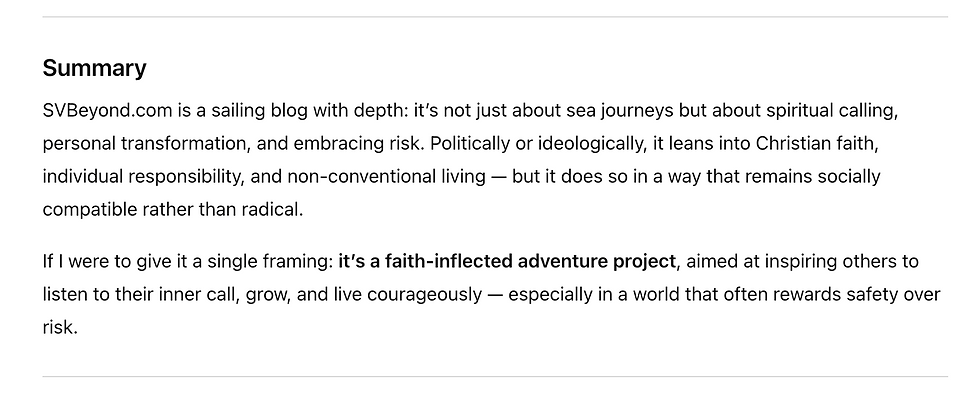
As a tool to define narratives, it is matchless. AI is becoming the de facto search engine, the go to place for when you want to understand something. It is already shaping all of our realities. Then it can distort undesirable worldviews, destroy them.
We struggle to define what is being censored. And who is defining what good looks like? Who is specifying what is output in response to your queries? Who defines the moral weightings of the algorithms? Who is creating the censorship?

We don't really know. But if you analyse the board of, say OpenAI, it's kind of eye opening. Do your own research but suffice to say that the links to Microsoft, Bill and Melinda Gates Foundation, Pfizer, and the CIA - to name just a few - are strong.
For a person that grew up in the 70s and 80s, that ridiculous. And kind of scary. I have always felt that I was a rebel - not particularly radical, but still, the power of this tool in the hands of Big Brother to sniff out dissenters...
As a tool for surveillance, how to resist?
Don't use it. It's of the enemy. Part of the shittification of everything.
Has humanity peaked? We sit at the peak of evolution, the apex predator, the most intelligent and only real tool user in the world. And at this peak, we create AI. Did we make ourselves obsolete?
No.
For a start, 'Artificial Intelligence' is not a thing. It's a frame that misrepresents. It's a lie. AI is no more intelligent that an electronic calculator, no wiser than a toaster. It's a tool. It's a deep language model with a big database. No more, no less. But it's very powerful.
We are made in God's image
There is power in the word. It's precious. And AI harlots it.
Treats it like a commodity, yet it's the holiest of holies. "In the beginning was the word..."
It's the Tower of Babel meets the Tower of Sauron in George Orwell's backyard and has a lovechild called AI.

It's the opposite of what God speaks to you through: your heart. It's more of the brain, and so so seductive to it. You go down that route of making it your god, don't be surprised when you lose another layer of your humanity.
It feels clever but makes you dumb. It feels profound but separates you from God.
God and you are creative. Lose that at your peril.
Addictive to screens. I sailed across an ocean with my phone guiding me. But I was addicted to the sea, not my screen.
You can no longer believe your eyes - think fake videos streaming in real time - you have to go to your discernment, your heart, God.
The truth cannot be programmed. It's not to be found in the brain. Or in AI. There is no such thing as your truth or my truth - there is only Truth. And it lives in the heart. We always argue about what's in our brains. It's always different and the differences clash. But when we share our heart with people, it's always the same as what's in their heart.
King Canute and AI, can we hold back the tide?

No we can't.
For a season, people will use it for everything. Businesses are already imbedding it in their processes. Your mission, should you choose to accept it, is to use it judiciously as a tool. But not as a source.
What AI can't do is speak from the heart. It doesn't have one. It can't be authentic. If you have ever used it, you have noticed how it sucks up in the most annoying way. Disingenuously, by whoever programmed it, it pretends and sets up a conversational tone as if between friends. AI girlfriends will do the same.
It can't do genuine. It can't do authentic. It can't do compassionate. It cannot mimic the heart. Which is why it can't out-blog SvBeyond.com.
We will undoubtably make mistakes, we will get things wrong. But we will never lie. We will always speak the truth as we see it. AI does not have the ability to speak the truth. It's only weighing letters, word patterns, statistics and probabilities and presenting back to you something that does not have the ability to be true.
And people will start to understand that.
We specifically and narrowly use AI to create illustrations for our website and blog articles. We hope to find artists in the future who can help us with these. But we don't use it for writing, not for revising, not for idea generation.
We're nervous about it.
Our hope is that our endeavours here inspire people to connect with the real world, by encouraging you to find a divine analogue inspiration.
Like dump your screens and go sailing.
Or whatever floats your boat.
All good,
Dan
Hi Dan - interesting blog as usual. I've been trying to contact you by email re. details of your junk rig - is info@svbeyond.com right? Where did you get your "do not comply" tee shirt btw? Thanks, Roger.